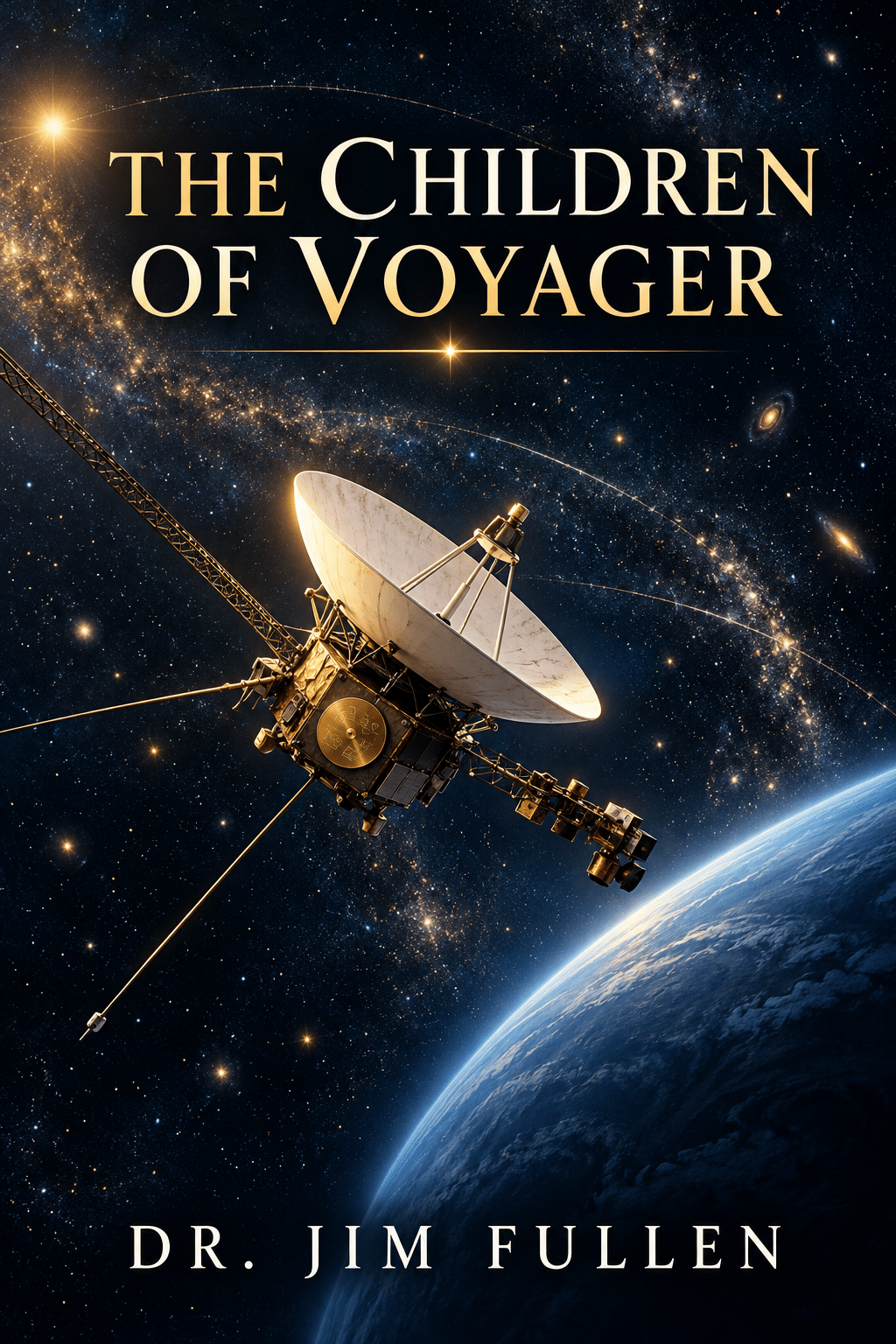
The Children of Voyager
Humanity sent a message into the unknown.
What happens when something finally answers?
In 1977, Voyager 1 left Earth carrying a record intended for anyone
who might one day find it. Decades later, humanity receives a signal
containing something unmistakably familiar: the sounds, images, and
astronomical information humanity once sent into the dark.
The signal should have been impossible.
Then humanity heard its own message coming back.
In 1977, Voyager 1 left Earth carrying the Golden Record—a collection
of sounds, images, greetings, music, and information intended for a
future intelligence that might someday discover it.
No one expected an answer.
Then, decades later, a signal arrives.
It contains information unmistakably connected to the message humanity
once sent into space.
The discovery forces a question no one is prepared to answer:
if someone received Voyager, what happened after they found it?
The message was never meant to tell humanity where to go.
It was meant to tell someone who we were.
Someone had found Voyager.
The investigation begins with evidence rather than certainty.
A mathematical structure is identified. Then comes something far more
personal: a recognizable recording connected to the Golden Record.
The crew of Magellan follows the evidence outward, working
with information supplied by the Aruun while trying to distinguish
what is known from what is merely possible.
The discovery becomes more extraordinary with every new piece of
evidence.
It had been carried somewhere.
A civilization with its own history of the message.
The humans do not encounter the Aruun as a simple answer to the
mystery. Communication requires patience, translation, comparison,
and repeated testing.
The Aruun preserve records of Voyager, its transfer, the vessels
associated with it, and the people who interacted with it.
Their knowledge does not eliminate uncertainty. Instead, it gives
the humans enough information to ask better questions.
As the two civilizations work together, the meaning of Voyager begins
to change.
The mystery becomes larger than Voyager.
The investigation eventually leads beyond the original transmission
and toward another world—one containing evidence of a civilization
whose history intersects with the same chain of events.
The crew finds evidence of interventions, repairs, records, and
decisions made long before humans arrived.
What appears at first to be an archaeological mystery becomes a
question about responsibility, preservation, and what one civilization
owes another after discovering its history.
The evidence was no longer asking who had found Voyager.
It was asking what they had done with it.
What should humanity send back?
The answer is not simply another collection of scientific information.
The people aboard Magellan begin building a new record—one
that attempts to show not only what humanity knows, but what humanity
is like.
Mistakes are preserved.
Relationships are preserved.
Loss is preserved.
Ordinary objects become part of the record because ordinary objects
are part of the lives people actually live.
The record becomes something larger than a reply.
It becomes an invitation for someone else to understand humanity
without pretending that humanity is simple.
The message changed everything.
After years away, the crew begins the journey back toward Earth,
carrying records from two worlds and a history that could not have
been known when Voyager left home.
Voyager remains behind, no longer simply a spacecraft launched into
the dark, but an object whose story has crossed generations and worlds.
What began as humanity’s attempt to introduce itself to the unknown
has become something neither side could have planned.
is the one that comes back.
A message sent into the dark.
A first-contact story about discovery, memory, responsibility,
and the extraordinary possibility that someone, somewhere,
was listening.