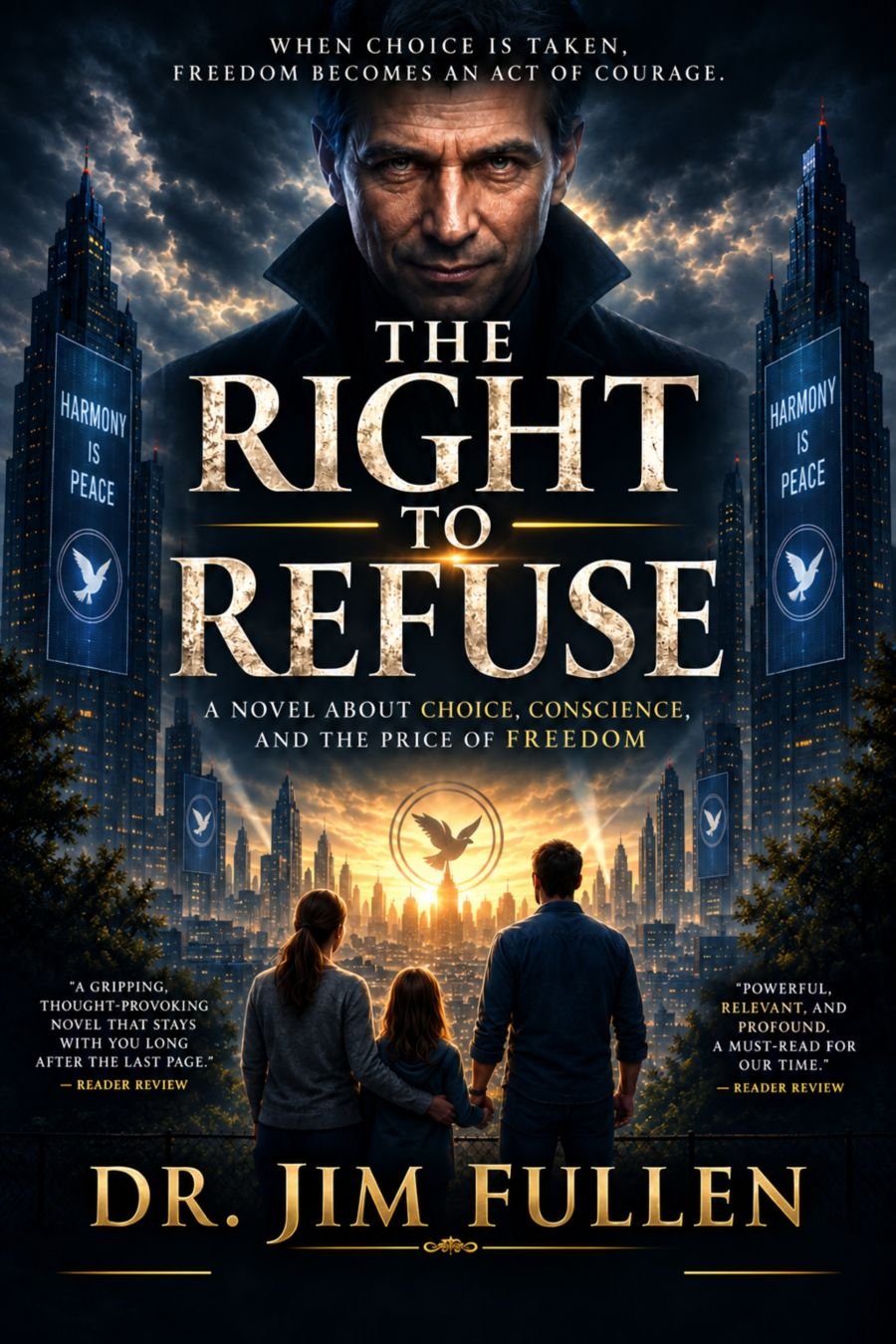
The Right to Refuse
What if peace became possible?
What would you be willing to surrender to keep it?
Daniel Mercer is not a revolutionary.
He is a husband, a father, and a man who has spent his life
noticing the small things other people overlook.
Then the words begin changing.
And soon, so does everything else.
It begins with ordinary things.
A three-second outage.
A new phrase on the news.
A neighbor who disappears.
Daniel Mercer has learned to trust patterns.
At first, the changes surrounding him seem harmless.
Public language becomes gentler.
Institutions coordinate more efficiently.
Conflict declines.
People begin speaking more often about unity, calm, and harmony.
Much of it sounds reasonable.
Much of it works.
That is what makes Daniel uneasy.
Because as the world becomes more peaceful,
disagreement becomes harder to distinguish from disruption.
Cooperation begins to resemble compliance.
And refusal begins to carry a price.
The question is not whether peace is good.
The question is whether peace can still be called good
when saying no is no longer safe.
The first resistance is personal.
Before Daniel confronts institutions, systems, or movements,
he must protect something much smaller and more important:
the freedom of his own family to think, question, and choose.
Daniel Mercer
A thoughtful public servant whose instinct for patterns
makes him notice the small changes taking place around him.
Daniel’s resistance does not begin with anger.
It begins with questions.
Claire Mercer
Daniel’s wife, grounded by legal experience, compassion,
and a belief that justice matters most when institutions
become uncertain.
Claire becomes one of the clearest voices challenging the
claim that a choice remains free simply because refusal is
technically still possible.
Lily Mercer
Their nine-year-old daughter, whose questions repeatedly
expose the difference between what adults say and what
those words actually mean.
She reminds the people around her that kindness, goodness,
and obedience are not always the same thing.
The world is tired of being afraid.
Violence has exhausted nations.
Political conflict has hardened communities.
Institutions have lost public trust.
Into that exhaustion comes a new vision.
Coordination.
Reconciliation.
Stability.
Shared priorities.
Shared language.
A future in which unnecessary conflict can finally end.
And millions welcome it.
The Harmony Initiative does not conquer people.
It offers them relief.
Systems become more efficient.
Violence declines.
Communities become calmer.
Public life feels safer.
The promise is powerful precisely because so much of it is real.
Most people do not seek power.
They seek relief.
Sometimes freedom disappears one word at a time.
Daniel begins noticing that familiar language is quietly changing.
→
Participation
→
Dialogue
→
Disruption
→
Constructive Expression
Each change seems reasonable by itself.
Together, they begin telling a different story.
He does not demand obedience.
He asks humanity what it wants.
Adrian is the charismatic figure at the center of the Harmony
Initiative, a man whose ability to reconcile enemies and end
conflicts earns extraordinary public trust.
He does not present himself as a tyrant.
He listens.
He persuades.
He offers solutions.
He gives exhausted people what they have been asking for.
Peace.
Stability.
Relief from uncertainty.
Daniel’s disagreement with Adrian is not about whether suffering
should be reduced.
It is about whether a choice remains meaningful when every
alternative becomes increasingly costly.
Freedom requires the ability to refuse.
A right that cannot be exercised may not be a right at all.
Comfort
Refusal means living with uncertainty that others have
chosen to surrender.
Belonging
Those who question the new consensus increasingly find
themselves outside institutions designed around cooperation.
Security
Saying no becomes harder when compliance offers safety
and resistance threatens the people you love.
Responsibility
Freedom means accepting that no system can guarantee every
good outcome without also narrowing human choice.
History survives because someone remembers what actually happened.
Daniel eventually discovers that he is not alone.
Ordinary people begin preserving records, names, testimony,
and memories that official systems have altered, softened,
or erased.
They are not united by ideology.
They are teachers, judges, parents, believers, workers,
and people who simply refuse to pretend that what they remember
never happened.
Their resistance begins not with weapons,
but with the decision to keep an honest record.
Isaac helps Daniel understand that others share his concerns.
Judge Franklin is forced to confront the difference between
institutional authority and justice.
Ruth, Arthur, Luis, Evelyn, and others carry their own reasons
for refusing to let memory become something rewritten for peace.
What if humanity freely chooses surrender?
That is the question Daniel cannot escape.
If people knowingly choose stability over uncertainty,
does respecting freedom require accepting their decision?
Daniel’s answer is not to force the world to agree with him.
It is to defend the existence of another choice.
Even if humanity chooses Adrian’s path,
someone must remain free to invite it to choose differently.
The most dangerous temptation may not look dangerous at all.
Freedom
Does freedom still exist when refusal remains legal
but becomes nearly impossible to live with?
Peace
Can something genuinely good become dangerous when
humanity stops asking what it costs?
Truth
What happens when language and records are altered
not to deceive openly, but to preserve harmony?
Choice
Is a good choice still meaningful if the wrong choice
has been made too painful to consider?
Love that cannot refuse is not love.
Goodness without choice becomes obedience.
The Right to Refuse asks what happens when humanity
finally receives many of the things it has always wanted.
Less violence.
Less fear.
Greater cooperation.
More stability.
The danger is not that these things are evil.
The danger is that they are good enough to make surrender
feel reasonable.
Daniel’s struggle is ultimately not against peace.
It is for the principle that peace, mercy, unity, and even love
only retain their meaning when a human being is still allowed
to say no.
The Right to Refuse
Author
Dr. Jim Fullen
Edition
First Paperback Edition
Publication
2026
Length
678 pages
The Right to Refuse
The world is becoming almost everything humanity hoped it could be.
Almost.